
Office Move Checklist: Your Complete Step-by-Step Guide

An office move checklist splits the relocation into five phases: planning (2-3 months before), preparation (4-8 weeks before), final preparations (2-4 weeks before), moving day and the first week after. Start with your lease notice period and IT, because they set the timeline for everything else. Below you’ll find each phase and a printable checklist.
Why You Need a Structured Office Move Checklist
Office relocation affects every aspect of your business simultaneously – employee productivity, client communication, IT systems, financial operations, and company morale. Without systematic planning using this office relocation checklist, chaos ensues on moving day. A dedicated team with clearly assigned responsibilities ensures each critical area receives proper attention during your office move.
Successful office moves require treating relocation as a project with distinct phases. A standard office move timeline — 2-3 months for planning, 4-8 weeks for preparation, and 2-4 weeks for final logistics — remains achievable when properly structured.

Phase 1: Planning (2-3 Months Before)
Planning in this phase involves choosing the right removal company, securing the new office space, and managing crucial logistics like budgeting and legal reviews. Prioritize these tasks early to avoid disruptions to your operations and ensure a smooth office relocation.
Conduct a Needs Assessment
Before selecting a removal company or setting budgets, identify which business operations can continue remotely (supporting remote employees), which require on-site presence (factoring in hybrid working models), and which present critical risks if interrupted. Document specific requirements: specialist removals for servers, temporary storage needs, packing services, office supplies inventory, and an existing office equipment assessment. This clarity prevents paying for unnecessary services whilst ensuring you don’t skimp on essentials for your new office space.
Establish Your Relocation Team and Budget
Appoint a dedicated project manager (who might use project management tools to track progress) and form a relocation committee with representatives from facilities, IT, finance, HR, and operations. Create a detailed budget covering moving team costs, storage, new office space preparation, furniture, IT infrastructure, address updates, legal fees for lease reviews, plus a 15-20% contingency for hidden costs and unexpected expenses.
Review Multiple Vendor Quotes
Obtain quotations from at least three professional removal companies. Assess what’s included: packing services, storage availability, insurance coverage, and more. Professional removal services prevent damage and costly mistakes, often delivering long-term savings despite higher upfront fees.
Select Your Moving Date and Notify Stakeholders
Choose a date that minimises business operations disruption. Avoid peak business periods, major deliverables, or tax deadlines. Summer represents peak moving season with higher costs — autumn or winter moves typically offer better pricing. Notify all stakeholders immediately: employees, clients, suppliers, local partners. This serves as the official notice.
Verify Leases and Book Your Removal Company
Check lease termination clauses for your old office and break options for both locations. Ensure your new office space lease provides flexibility. Book your removal company early – professional services book up quickly during peak seasons.

Phase 2: Preparation (4-8 Weeks Before)
Preparation focuses on auditing existing assets and planning the physical and technical setup. Proper office layout planning, comprehensive inventory checks, and IT infrastructure coordination are essential to minimize delays and operational disruption.
Audit Your Inventory and Plan Office Layout
Audit your inventory. Decide what existing furniture and office equipment moves, what stays, what sells, and what gets recycled. This space planning analysis reduces unnecessary transport volume and moving costs. Create a detailed office layout (floor plan) for your new office space showing furniture placement and access points. Create another detailed floor plan with utility locations marked. Document all office equipment and office supplies requiring management.
Create a standardised labelling system using colour-coded tags linked to a master inventory spreadsheet. This prevents lost items whilst building team ownership.
Conduct New Office Assessment
Verify utilities function (electricity, water, heating, internet, telephone lines), confirm furniture delivery dates, arrange professional cleaning services, and check security (including access control systems) and parking. Identify potential obstacles – narrow doorways or tight corners – requiring specialist equipment. Assessment of your new office space prevents moving-day surprises.
Coordinate IT Infrastructure Transition
The IT transition represents the highest-risk component of any office relocation. Audit all tech equipment (IT assets): computers, servers, printers, phones, routers, and specialised equipment. Develop a detailed IT infrastructure transition plan. Schedule system testing immediately after equipment arrives – before employees arrive. Strong IT infrastructure planning ensures business operations continuity.
Plan Communications and Team Involvement
Develop a communication strategy addressing key stakeholders directly. Communicate new office space details, parking arrangements, public transport access, and responsibilities for specific team members. Communicate the new office address clearly. Notify employees early and involve them in planning discussions – this transforms office relocation from something imposed into something staff help shape. Keep your team informed throughout the moving process.

Phase 3: Final Preparations (2-4 Weeks Before)
Final preparations ensure your office move proceeds smoothly by confirming logistics, updating information, and verifying site readiness. Effective coordination and communication during this phase prevent last-minute issues.
Confirm Logistics and Begin Packing
Finalise details with your removal company: arrival time, team size (you may need to book parking space permits for the vans), and special requirements. Two weeks before moving day, begin packing non-essential items – archived documents, office supplies, and unnecessary equipment – using proper packing supplies. Develop a detailed moving plan (not just a moving day plan) for effective coordination. Establish temporary storage arrangements if additional space is needed.
Update Information and Verify Readiness
Update your new address across all platforms – website, email signatures, social media, business directories, and contact details. Ensure your address appears consistently everywhere. Communicate your new office location to all key stakeholders. Update Companies House records and notify HMRC of your relocation.
Schedule final walkthrough of both locations. At your current office, confirm items earmarked for movement. At your new location, verify utilities functioning, new furniture delivery scheduled, and security systems operational.
Order new branded materials – business cards, letterhead, envelopes, signage – reflecting your new location details.
Phase 4: Moving Day
Assign staff coordinators at both locations. Ensure all employees have cleared their personal belongings from the old office. Your removal team should coordinate with on-site staff. Use your labelling system consistently: mark each box with department, contents, and destination room.
Provide refreshments for both removal staff and on-site personnel. Begin IT equipment setup immediately upon arrival. Install network switches and servers first, allowing IT teams to establish infrastructure whilst physical items (like desks and office plants) are being unloaded. Conduct immediate system testing to identify issues before employees arrive.
Phase 5: Post-Move Settlement (Days 1-7)
Begin unpacking immediately, prioritising the new office setup. Focus on workstations and IT systems needed on day one. This initial office setup is critical for day-one operations. Assign unpacking responsibilities across your team. Conduct a welcome tour for all employees on their first day in the new workspace, demonstrating security systems and clarifying procedures.
Verify all systems function correctly: IT networks, phones, security systems, climate control, and lighting. Create a formal punch list for remaining tasks. Address unexpected expenses immediately. Conduct a post move evaluation to see what lessons were learned. (And maybe plan an office warming party).
Your Office Move Checklist
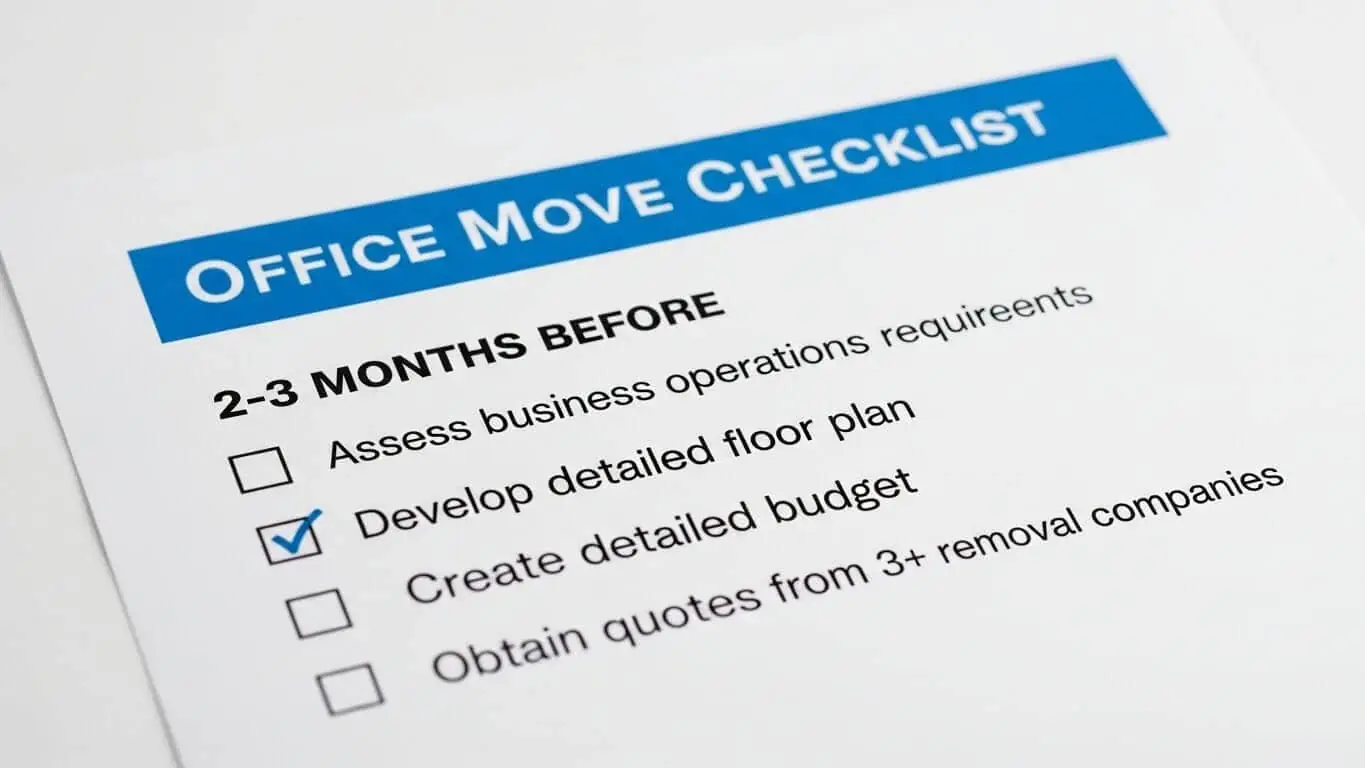
2–3 Months Before
- Assess business operations requirements and new office space needs
- Develop detailed floor plan for your new office location
- Develop additional detailed floor plan with utilities and access points
- Appoint project manager and relocation committee
- Create detailed budget with 15–20% contingency (includes research costs)
- Obtain quotes from 3+ removal companies
- Select moving date and notify all stakeholders
- Review lease terms and book removal team
4–8 Weeks Before
- Audit office equipment and office supplies inventory
- Create labelling system and move checklist
- Conduct IT asset audit and plan IT infrastructure
- Develop communication strategy for stakeholders (include key milestones)
- Arrange professional cleaning services
- Establish temporary storage arrangements if needed
- Plan employee communication and moving process
2–4 Weeks Before
- Confirm logistics with your removal company (managing logistics)
- Begin packing office supplies and non-essential equipment
- Update office address on all digital platforms
- Schedule final walkthrough of both locations
- Prepare new branded materials with location details
- Arrange security systems activation
Moving Day
- Coordinate removal team and on-site staff
- Ensure proper labelling for moving day execution
- Begin IT equipment setup and infrastructure installation
- Conduct system testing before employee arrival
- Maintain positive moving environment
Days 1–7 Post-Move
- Prioritise workstation setup
- Conduct employee orientation
- Verify all systems functioning
- Complete punch list and resolve issues
- Update new address details on remaining platforms
- Notify stakeholders of successful office move
Key Success Factors
A dedicated project manager provides essential oversight. Multiple vendor quotes maintain financial control. Team involvement encourages ownership throughout moving process execution.
Proactive communication with employees, clients, suppliers, and key stakeholders prevents operational disruptions. A contingency plan allows flexible problem-solving when unexpected expenses arise. Immediate system testing prevents discovering non-functional systems after employees arrive.
Begin planning your office move now with realistic timelines, appoint clear project ownership, maintain stakeholder communication, and approach your office move as a focused business operations project. This professional approach transforms office relocations from organisational disruptions into successful transitions enabling your business to thrive in its new office location.
Office Move Checklist: Common Questions
Start planning two to three months before the move for a small or mid-sized office, and earlier if you have a long lease notice period or complex IT. Your lease terms usually set the real deadline: check the notice period and any reinstatement obligations first, then work backwards to book your removal company, IT contractors and the moving date.
A practical timeline covers five stages: planning (budget, team, quotes), preparation (inventory, new office layout, IT and phone lines), final preparations (packing, labelling, updating your address), moving day itself, and a settling-in week to fix snags. Give every task an owner and a deadline, so nothing depends on one person remembering it.
Tell staff first, then clients, suppliers and your bank. Update your registered office address with Companies House if it changes, and notify HMRC, your insurers, utility providers and IT or telecoms suppliers. Update your website, Google Business Profile, email signatures and printed materials, and set up mail redirection for the first months after the move.
If you have staff carrying equipment, yes - employers have to assess manual handling risks under UK health and safety rules. A simple risk assessment covers heavy or awkward items, stairs and lifts, access and parking at both addresses, and IT equipment handling. Using a professional removals company moves most of the lifting risk to trained crews.
Often, yes. A weekend or out-of-hours move keeps downtime low, because staff leave on Friday with a packed desk and start on Monday at the new address. Check access first: some office buildings restrict lift use or loading bays at weekends, and IT providers may charge more outside working hours.