
How to Transport a Mattress: A Step-by-Step UK Guide

To transport a mattress safely, measure it and your vehicle first, seal it in a heavy-duty mattress bag, lift it level with at least one helper, and lay it level inside a van rather than on the roof or on its side. Never bend a pocket sprung mattress – the coils will snap and the warranty is void. Memory foam and latex mattresses can be rolled temporarily if the manufacturer allows it, and a vacuum compression bag can shave a few centimetres off the thickness to help it fit inside a car boot.
Proper preparation prevents permanent damage and keeps the mattress clean. It protects three things at once: the mattress covers (usually damask, knitted polyester or Tencel), the internal fillings (pocket springs, memory foam, latex or cooling gel layers) and the manufacturer’s warranty, which is typically void if the item arrives stained, damp or creased.
UK Mattress Sizes and Weights
Before you plan the move, find out exactly which UK mattress size you own. The mattress size dictates the vehicle you need, the number of helpers, and whether you can even get it through a standard 76 cm door frame.
| Size | Imperial | Metric | Typical weight |
|---|---|---|---|
| Small single | 2’6″ x 6’3″ | 75 x 190 cm | 10-15 kg |
| Single | 3′ x 6’3″ | 90 x 190 cm | 15-25 kg |
| Small double | 4′ x 6’3″ | 120 x 190 cm | 25-35 kg |
| Double | 4’6″ x 6’3″ | 135 x 190 cm | 30-40 kg |
| King | 5′ x 6’6″ | 150 x 200 cm | 40-55 kg |
| Super king | 6′ x 6’6″ | 180 x 200 cm | 55-80 kg |
| Emperor | 6’6″ x 6’6″ | 200 x 200 cm | 60-90 kg |
💡 Moving Tip: Not all mattresses within the same size bracket weigh the same – construction type matters as much as dimensions.
A standard UK internal doorway is around 76 cm wide; an external front door is typically 80-90 cm. Anything double size or larger will have to go through diagonally or on its edge.
What You Need for Transporting a Mattress
Gather the right equipment in one place before you start, so you are not searching for tape with a half-wrapped mattress blocking the hallway. A typical London move takes 60-90 minutes from first lift to final placement.
Essential kit:
- Heavy-duty mattress bag or plastic wrap sized to the mattress (double, king, super king)
- Packing tape (50 mm wide), duct tape or gaffer tape, and sharp scissors
- Two or more ratchet straps or tie-down straps – avoid bungee cords, which stretch under load and cannot hold a mattress securely during sudden stops or sharp turns
- A clean dust sheet or old blanket for the van floor
- Work gloves for grip and finger protection
- Torch or phone light for checking under the mattress
- A vacuum cleaner with a HEPA filter and upholstery attachment to remove dust, allergens and debris
Optional but useful:
- Vacuum storage bag (foam mattresses and latex mattresses only)
- Painter’s plastic sheeting (4-mil polyethylene) as a budget wrap alternative
- Moving blankets to pad sharp van fittings
- A furniture dolly, trolley or glide sliders if you have one
- A metal tape measure – do not guess dimensions, and avoid fabric tapes which stretch
- A second roll of cling film for extra outdoor protection
- An enzyme cleaner or upholstery cleaner for pre-move stain removal
Vehicle options in UK:
- Car boot (estate or hatchback): fits a single rolled foam mattress or a small single at a stretch
- Large SUV with a folded rear bench: fits a single or small double laid level, a workable alternative if you cannot hire a van
- SWB Ford Transit or equivalent small van: fits a single or double mattress level across the load bay
- LWB Ford Transit, Mercedes Sprinter, Vauxhall Movano or Luton van with a tail lift: fits a super king, with more space for bed frames and bedding
- [Man with a van services](/services/man-van-london/): usually an LWB Transit with one or two removal men, the best budget option for a single item
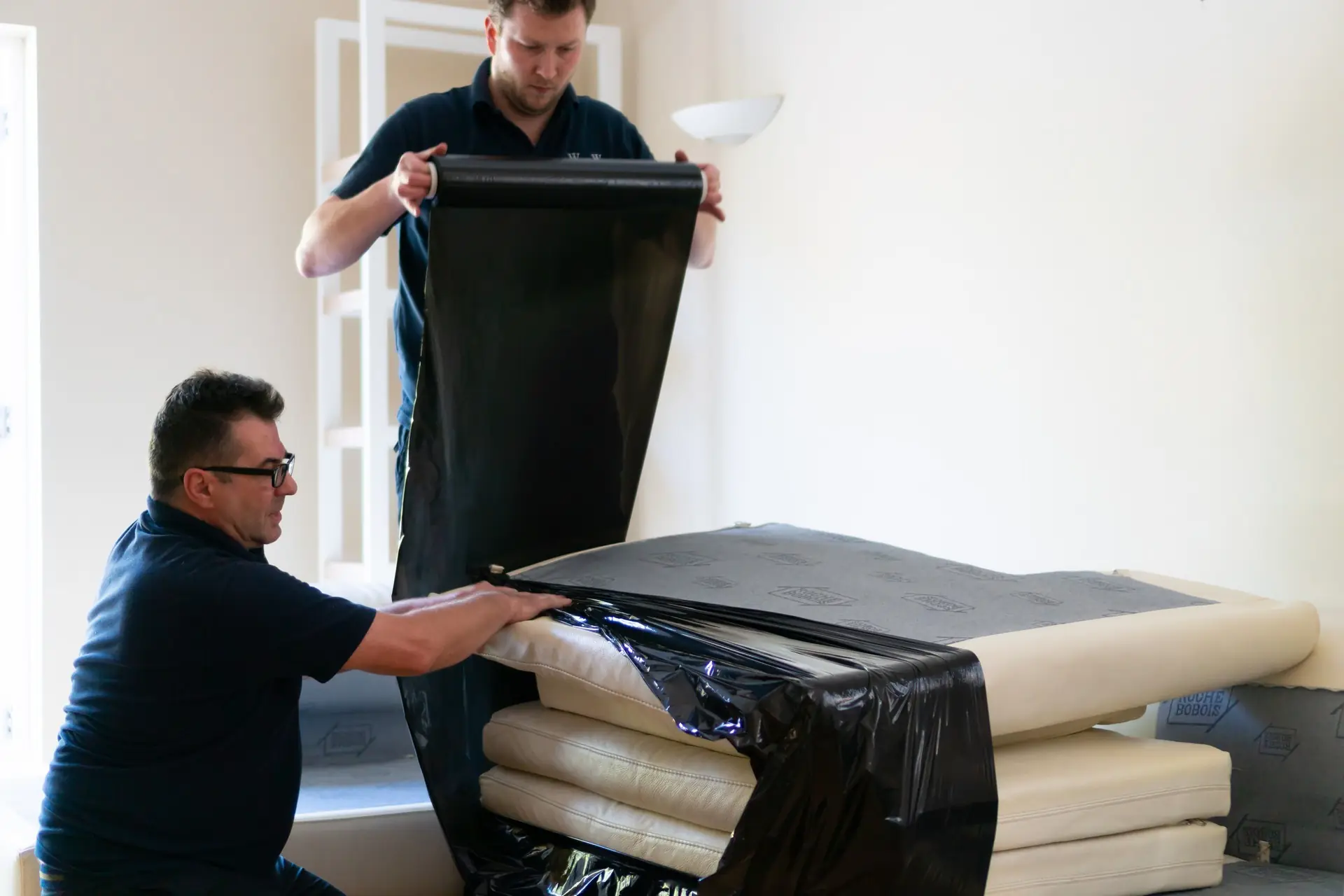
How to Transport a Mattress Step by Step
Measure everything, strip and wrap it, clear the route, lift with a helper, load it level in a van, secure it with tie-downs, then drive slowly and unload onto the bed frame. A typical move takes 60-90 minutes and requires one helper minimum, two for king or super king. The mattress must arrive clean, dry and straight onto a flat surface – never bent, never on its edge for more than a few minutes, and never dragged.
Step 1 – Measure the Mattress, Doorways and Vehicle
Measure the bed, every doorway it has to pass through, the staircase width, the landing clearance and the load space of the moving vehicle you plan to use.
Use a metal tape measure (not a fabric one) and record width, height and diagonal clearance at every pinch point: the bedroom door, the landing turn, the front door, the lift car (if a flat), the van’s rear door aperture and the internal load bay length. Double check the numbers and write them down. A king size mattress is 150 x 200 cm and a double mattress is 135 x 190 cm, but add at least 5 cm of clearance to each figure because a wrapped bed is always thicker than a bare one.
Pay special attention to the corner between the stairs and the landing in a Victorian terrace or mansion block – this is where most moves get stuck, and there is rarely a way around it once you have lifted the load off the floor. Check the lift’s maximum load dimensions with the building manager if you live in a mansion block – many London lifts cannot accommodate anything larger than a small double on its edge.
Step 2 – Strip, Clean and Wrap the Mattress
Strip off all sheets, protectors and pillows. Vacuum both the mattress top and underside with a HEPA-filter hoover and upholstery attachment to remove dust, dust mites, skin cells, pet hair and pollen. Pay particular attention to the piping along the edges and the quilted seams, where debris collects. For stains, blot (do not rub) with an enzyme cleaner or upholstery cleaner diluted in lukewarm water, then allow the surface to air-dry fully before wrapping. Sealing damp bedding material in plastic encourages mildew and dust mite regrowth within 24-48 hours.
Slide a heavy-duty bag over the bed while it is lying level on the floor. Push out as much air as possible, then seal the open end with packing tape in a zig-zag pattern so the bag cannot peel open in transit. If you still have the original vacuum-sealed plastic wrap the bed came in, you can use that instead – it is already sized correctly and usually waterproof.
As a budget alternative, painter’s plastic sheeting (typically 4-mil polyethylene) works well for single-use moves. Wrap the bed twice, mitre the corners like a parcel and seal every seam with duct tape or gaffer tape. Avoid masking tape – it loses adhesion in cold van interiors. For longer storage, a breathable cotton cover is better than plastic, which traps moisture.
Step 3 – Plan and Clear the Route
Walk the full route from the bedroom to the van before you lift anything. Remove picture hooks, wall art, coat stands and anything else that could snag the mattress cover. Prop open every door between the mattress and the van with a door wedge or a heavy book to save time and save money on a potentially damaged cover.
Never drag the mattress across carpet, laminate, tile grout lines or a tarmac driveway – dragging abrades the ticking fabric, pulls loose tufting buttons and can snag on screw heads protruding from skirting boards or van wheel arches. Use a furniture dolly or glide sliders instead, and never rely on the handles sewn onto the side, which are designed for positioning on the bed frame, not for carrying the full weight.
On stairs, identify who will take the bottom end (the strongest family member or helper – they carry most of the weight and control the descent) and who will take the top. Clear one landing or hallway space where you can safely rest the mattress if you need a breather.
Step 4 – Lift the Mattress Safely for Safe Handling
Safe handling of heavy lifting starts with technique. Lift with your legs, not your back. Bend at the knees, keep the mattress close to your body, brace your core, and stand up in one smooth motion. Two people should grip opposite short edges (the 135 cm ends of a double, not the 190 cm sides) so the mattress inside the bag stays in a manageable shape.
Communicate clearly with commands like “lift”, “step”, “pivot” and “down”, and always count down “3, 2, 1, lift” before any movement on stairs.
To avoid injury, lifting strains – lower back pain, shoulder impingement and trapped fingers – are among the most common complaints reported during DIY local moves. For king or super king sizes, use ratchet straps as lifting handles: loop one around each end about 30 cm from the edge, leaving a hand loop on each side. The tie-downs take the load off your fingers and prevent the bag from slipping.
Step 5 – Load the Mattress Into the Vehicle
Lay the bed level inside a van wherever possible – not on its side. A mattress resting on its edge will slump over corners, warp the internal structure, and is more likely to shift during braking. Place it on a clean dust sheet in the van bed, with moving blankets between the cover and any sharp van fittings or tie-down rails.
Check that the van has load-lashing eyes or a ratchet rail along the floor before driving off – many older vehicles do not, which makes it impossible to secure the mattress properly.
Roof racks are the last resort, not the first choice. Wind, rain and UK weather can soak, tear or rip the bedding off roof racks even with secured tie-downs, and most manufacturers explicitly warn against it. If you have no other option, use a full-width roof rack, two tie-downs fed through the car windows at the front and rear, and drive below 40 mph avoiding motorways altogether. Never use only the door frames as anchor points, and never substitute bungee cords for proper tensioned straps – bungee cords cannot provide the hold needed for a large load on a moving vehicle.
Step 6 – Secure With Straps
Inside the van, run one or two tensioned tie-downs across the bag and anchor them to the van’s load-lashing points to secure the mattress for the journey. A gentle tension is enough; you do not need to crush the padding. Do not stack heavy boxes, heavy items or furniture on top – compression from bedside tables, stacked book boxes, toolboxes or a disassembled bed frame leaves dents in memory foam that can take weeks to recover and can permanently collapse pocket coils.
If space is tight, load only lightweight, flat items on top such as duvets, pillows, cushions or soft-sided laundry bags. Keep sharp-cornered items like mirrors, picture frames, lamp bases and kitchen appliances well away from the surface.
Step 7 – Drive Carefully and Unload Onto a Flat Surface
Drive slowly and gently with extra stopping distance, especially on the first few miles while you get used to the weight distribution. Avoid sudden stops and sharp turns, which can shift even a well-strapped load. Watch your blind spots more carefully than usual because a big bag inside the van can obstruct the rear-view mirror.
At the destination, carry the bed straight from the van to the bed frame. Lay it on a flat surface as soon as possible – ideally the bed frame itself, or a level floor if the frame is not yet assembled. Do not leave it standing on its side while you unpack other items – the longer it stays in a non-level position, the more likely it is to develop a permanent bow, which will ruin your chance of a good night’s sleep on the first evening in the new home.

Can You Transport a Mattress in a Car?
Yes, but only a small single, single or small double, and only in an estate, hatchback or large SUV with the rear seats folded down for more room.
A bare single mattress (90 x 190 cm) will usually slide into a medium estate if you fold the front passenger seat forward; a small double (120 x 190 cm) needs more space – a larger estate such as an Octavia or Passat, or a large SUV with a long load bay. Anything double (135 x 190 cm) or larger will not fit inside a typical family car without bending, and bending a pocket sprung mattress damages it.
If your car is not big enough, you have three realistic options: hire a van for the day, book a man with a van for a few hours, or call a removals firm. A man with a van is usually the cheapest for a single-item move within London.
Can You Fold a Pocket Sprung Mattress?
No. Bending a pocket sprung mattress deforms the steel coils, snaps the calico pocket stitching that holds each coil in position, and voids the manufacturer’s warranty. The same rule applies to open-coil (Bonnell), continuous coil, innerspring mattresses, hybrid and orthopaedic constructions – any build containing steel wire under tension must be transported level, or on its edge for the shortest possible time.
Memory foam, latex (both Talalay and Dunlop), polyurethane foam and reflex foam are viscoelastic or elastomeric materials that tolerate short-term compression. They can usually be rolled up for a short period (a few hours) without permanent damage, provided you follow the next section.
How to Transport a Memory Foam Mattress
Memory foam and latex mattresses can be rolled up for a short move, and a vacuum compression bag will shave 3-5 cm off the thickness to help the roll fit inside a car boot.
Most modern foam and hybrid mattresses sold online arrive at the customer’s door rolled and compressed in a vacuum-sealed box, which confirms that this type of foam can be re-rolled briefly
Check your manufacturer’s warranty first, however – some makers still do not allow re-rolling, and some hybrid models with a pocket spring core cannot be re-rolled even if the top layers are soft.
To roll a memory foam mattress:
- Strip all bedding and hoover the surface.
- Slide it into a strong plastic wrap or bag.
- Optional: place the wrapped bed inside a vacuum storage bag and use a hoover to draw the air out. It will flatten by several centimetres.
- Starting from one short end, fold it over once onto itself, then slowly roll it into a tight cylinder.
- Secure the rolled cylinder with two tensioned tie-downs – one near each end.
- Unroll it within 24 hours of arriving at your new home and lay it on a flat surface. Give it at least 24-72 hours to recover its full thickness before you sleep on it.
Never keep a memory foam mattress rolled up for an extended period longer than the manufacturer allows. Leaving it rolled for days or weeks can permanently distort the foam cells and leave ridges you can feel through the sheets.
How to Transport a Mattress Without a Car
If you do not own a car, the two cheapest UK options are to hire a moving truck or van for a few hours, or to book a man with a van. For a typical London move, expect to pay around £40-£80 for a self-drive SWB van for 3-4 hours, or £60-£120 for a man-and-van service with one helper. Most moving trucks rented in the UK are LWB Transits or Luton vans – both allow the bed to lie fully flat throughout the journey, which is the safest configuration for transportation.
Your options in order of cost:
- Man with a van – the cheapest service option for a single item, especially over a short distance. You get at least one mover who will help lift.
- Self-drive van hire – nationwide rental firms and local independents all rent SWB and LWB Transits, Mercedes Sprinters and Vauxhall Movanos by the hour. Check the load length before booking: a super king (200 cm) will not fit in a short wheelbase van.
- Professional movers from a removals firm – the right choice if the mattress is part of a larger house move.
- Shared transportation / part-load – specialist removal websites pair you with couriers already travelling your route. Slower but can be very cheap.
- Courier collection + delivery – some courier firms will handle single mattresses as oversized items.
- Storage facility transfer – if you are between homes, many self-storage sites offer a combined collection and storage facility service so the bed is handled only once during the moving process.
Common Mistakes When Moving a Mattress

Most damaged beds fall into one of six categories. Avoid these and your bedding will arrive in the same condition it left.
- Bending a pocket sprung mattress. Deforms the coils, snaps the stitching, voids the warranty.
- Strapping it to the car roof without a proper rack. High-speed wind tears the bag and can rip the bed clean off. Using bungee cords instead of proper tie-downs is equally dangerous – they cannot hold the tension needed on a moving vehicle.
- Not wrapping it first. A bare surface picks up grease, dirt and moisture from the van floor within minutes. Condensation, plaster dust from doorways and grease from van floors are the three most common contaminants during a move.
- Leaving it on its edge for hours. Even constructions that can briefly stand on edge will start to bow if you forget about them during a long unpack.
- Solo lifting a king or super king. At 55-80 kg, these are a two-person job at minimum. Back injuries from solo lifts are one of the most common UK moving-day complaints.
- Keeping a memory foam mattress rolled for more than 24 hours. The foam cells compress and can leave permanent ridges.
Should You Hire Professional Movers for Your Mattress?
Professional movers are the simplest choice for any king or super king, any move that involves stairs or tight corners, and any move that is part of a larger house relocation. These situations significantly increase the injury and damage risk when you try to handle the heavy lifting yourself.
At W & W Movers, our teams regularly transport mattresses alongside beds, bed frames and full bedroom furniture sets as part of our London house removal service. We bring professional-grade bags, moving blankets and tensioned tie-downs as standard, and our teams are trained to manoeuvre large items safely in the specific conditions common to London properties – including Victorian terrace staircases, mansion block lifts, narrow hallways and basement flats.
If you would like us to handle the transportation of your bedding and the rest of your bedroom furniture, contact our team for a quick summary quotation. We can assess your requirements and confirm what is included in your removal service.
Frequently Asked Questions
Measure the bed, the doorways and the vehicle first, seal it in a heavy-duty bag, lift it with at least one helper, and lay it flat inside a van. Secure it with tensioned tie-downs and drive slowly. Never bend a pocket sprung model, and only roll a memory foam one if the manufacturer allows it.
Yes, but only smaller sizes (small single, single, small double) and only in an estate, hatchback or large SUV with the rear seats folded down. A double (135 x 190 cm) or larger will not fit inside a normal family car. If your car is too small, hire a van or book a man with a van instead.
No. Bending a pocket sprung, innerspring or hybrid construction deforms the steel coils, snaps the stitching and voids the warranty. Transport spring mattress models level at all times. Only memory foam, latex and pure-foam options can be rolled temporarily, and only if the manufacturer permits it.
Most memory foam and hybrid products need 24-72 hours to fully expand after unrolling, although you can usually sleep on them after the first few hours. Follow your manufacturer’s timing because some premium foams need up to a week to reach their final feel.
Put it inside a van and lay it on a flat surface. A self-drive SWB or LWB Transit will take any size up to super king. A man-with-a-van service is usually cheaper for a single-item move and includes a helper to carry it.
A standard UK king size (150 x 200 cm) typically weighs 40-55 kg, and a super king (180 x 200 cm) weighs 55-80 kg depending on whether it is foam, pocket sprung or hybrid. Always lift a king or super king with at least one helper.
Yes, but only on memory foam, latex or hybrid options, and only for a short move. A vacuum storage bag can shave 3-5 cm off the thickness and make it easier to fit inside a car boot. Unroll and unpack within 24 hours of arrival and let it expand for 24-72 hours before sleeping on it. Never vacuum-compress a pocket sprung build.